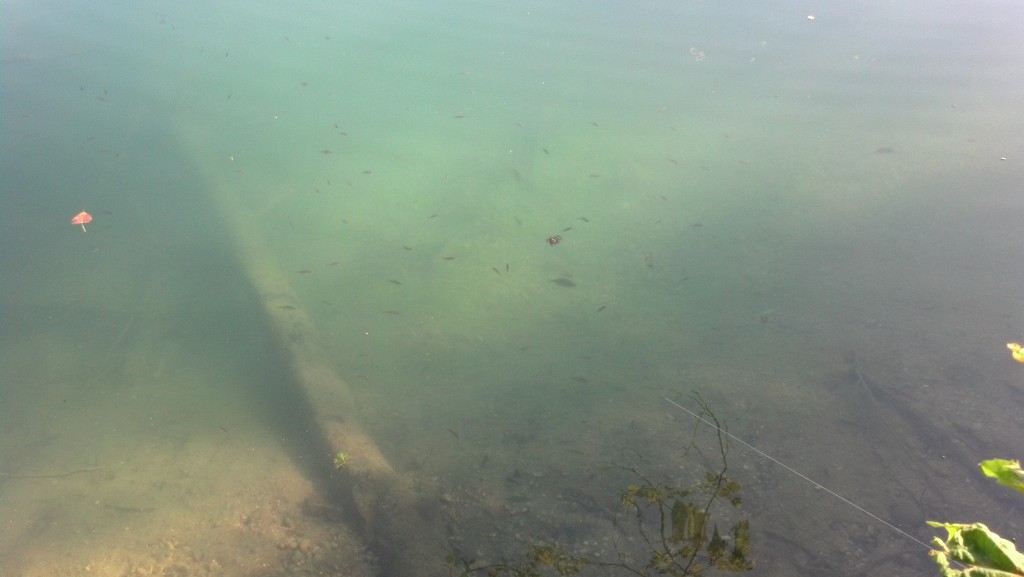
Here is a picture taken topside while the camera was in the water. All of those black spots are hundreds of fish.
And here is a small highlight clip I have over the 90 minutes of video I took that day. I have 3 or 4 of these highlight clips, some showing some rather large fish. The water is roughly 10-12 feet deep on the first portion of this video. You can still see the bottom crystal clear.
https://www.youtube.com/watch?v=GLjgt1Wm_M8
My current plans for my ROV are to use 3 1100 LPH bilge pumps with props, two forward facing for forward/reverse and one vertical for ascend/descend. I'll be using DPDT relays and a joystick using this schematic:
http://www.homebuiltrovs.com/howtojoystickdpdt.html
The Joystick I purchased is here:
http://www.ebay.com/itm/310570260430?ss ... 1439.l2649
I'm using 2 100 foot Ethernet (Cat5) cords for a tether. One for controls, one for video (I'm not sure if I can stream 480p video on a single twisted pair at 100 ft). I'll be doing a sort of french braid with a buoyant material to keep the tether as neutral as possible. My confusion comes in powering it. The current plan is to use a couple of 3500 mAH power cells that are mounted on the ROV itself. They will provide the power and ground directly to the relays as well as the main source of ballast. So I'm wondering about the actual controls. Where will the power come from that is sent through the joystick and down to the relays? Do I need to have another battery pack mounted in the controller? How much voltage/amps do I need to send to the relays through the tether? I'm very confused on this part, and any help is greatly appreciated.