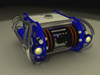
 : See image below for better reference. Now keep in mind that in the picture the o-rings are between the end caps and the polycarbonate tube. The redesign has the o-rings between the ends of the polycarbonate tube and the end caps which are aluminum. The two will be compressed using the side plates as a "vise." The side plates are held together using 5/16" aluminum "struts" which can be dialed in for optimum compression. (See my work in progress post for actual rov in progress.)
Polycarbonate camera housing questions.
Polycarbonate camera housing questions.
Sending out a question to you all... Does anyone know the best way to make the ends of my polycarbonate camera housing ultra smooth since they are going up against o-rings? : See image below for better reference. Now keep in mind that in the picture the o-rings are between the end caps and the polycarbonate tube. The redesign has the o-rings between the ends of the polycarbonate tube and the end caps which are aluminum. The two will be compressed using the side plates as a "vise." The side plates are held together using 5/16" aluminum "struts" which can be dialed in for optimum compression. (See my work in progress post for actual rov in progress.)
: See image below for better reference. Now keep in mind that in the picture the o-rings are between the end caps and the polycarbonate tube. The redesign has the o-rings between the ends of the polycarbonate tube and the end caps which are aluminum. The two will be compressed using the side plates as a "vise." The side plates are held together using 5/16" aluminum "struts" which can be dialed in for optimum compression. (See my work in progress post for actual rov in progress.)- Attachments
-
- fish6.jpg (303.67 KiB) Viewed 8608 times
-
SoakedinVancouver

- Posts: 117
- Joined: Dec 31st, 2010, 9:38 pm
Re: Polycarbonate camera housing questions.
Is the poly tube wall thick enough to have a groove machined into the ends of it? If so, the aluminum is "easy" to smooth out evenly, more so, I believe, than the poly. Dual o-rings in this configuration on the camera dome used to give us greater than 650 feet depth...
Damn fine looking machine you've got!
Stephen
Funny, computers can't spell aluminium???
Damn fine looking machine you've got!
Stephen
Funny, computers can't spell aluminium???
Re: Polycarbonate camera housing questions.
Paul,
We have built several camera housings using a polycarbonate tube with aluminum plugs sealed with an o-ring. When the o-ring is compressing against the inside of the polycarb tube as in your picture (and mine attached) we haven't found a need to smooth or buff out the polycarb. This is with a 6" diameter x 1/8" thick tube. We noticed, as you probably have, that the polycarb tube doesn't seem very uniform, but it still seals great. In the attached picture you can see that the bead where the o-ring is sealing to the tube is a uniform thickness all of the way around.
Some words of caution: make sure you measure the actual size of the tube instead of going off of it's nominal dimensions... Our tube was about 1/16" off of the listed diameter. Also, when you have the plugs as wide as they are in your design, it takes a lot (a whole lot!) of effort to insert them into the tube. If this is an issue you can try making them thinner, or install a vent that you can open when assembling.
Very nice looking project, by the way!
-Steven
We have built several camera housings using a polycarbonate tube with aluminum plugs sealed with an o-ring. When the o-ring is compressing against the inside of the polycarb tube as in your picture (and mine attached) we haven't found a need to smooth or buff out the polycarb. This is with a 6" diameter x 1/8" thick tube. We noticed, as you probably have, that the polycarb tube doesn't seem very uniform, but it still seals great. In the attached picture you can see that the bead where the o-ring is sealing to the tube is a uniform thickness all of the way around.
Some words of caution: make sure you measure the actual size of the tube instead of going off of it's nominal dimensions... Our tube was about 1/16" off of the listed diameter. Also, when you have the plugs as wide as they are in your design, it takes a lot (a whole lot!) of effort to insert them into the tube. If this is an issue you can try making them thinner, or install a vent that you can open when assembling.
Very nice looking project, by the way!
-Steven
- Attachments
-
- o-ring seal on main housing of 'Babs'
- wiring07.jpg (137.39 KiB) Viewed 8569 times
Re: Polycarbonate camera housing questions.
Steven,
If you don't mind me asking... How did you seal the wires coming into the housings?
If you don't mind me asking... How did you seal the wires coming into the housings?
Re: Polycarbonate camera housing questions.
You also have a darn fine looking machine.
Re: Polycarbonate camera housing questions.
Thanks Paul!
Wires are also sealed with o-rings, using the same concept as the polycarb/aluminum plug seal. A hole with a deep countersink is drilled where each wire will go, and the hole is sized to compress an o-ring around each wire. See the diagram I attached for a cross sectional view.
In one of our past ROVs we used Bulgin connectors, which ended up working okay after working through all the kinks. They were pretty expensive though.... and we saw water inside of our main compartment on numerous occasions. The benefit of the o-ring approach is that it costs about a nickle to seal each wire. We've yet to get any water inside of our main compartment after many dives (mind, they were only in 13ft deep swimming pools).
By the way, more information about that ROV can be found here: http://www.selectric.org/nurc10/index.html
-Steven
Wires are also sealed with o-rings, using the same concept as the polycarb/aluminum plug seal. A hole with a deep countersink is drilled where each wire will go, and the hole is sized to compress an o-ring around each wire. See the diagram I attached for a cross sectional view.
In one of our past ROVs we used Bulgin connectors, which ended up working okay after working through all the kinks. They were pretty expensive though.... and we saw water inside of our main compartment on numerous occasions. The benefit of the o-ring approach is that it costs about a nickle to seal each wire. We've yet to get any water inside of our main compartment after many dives (mind, they were only in 13ft deep swimming pools).
By the way, more information about that ROV can be found here: http://www.selectric.org/nurc10/index.html
-Steven
- Attachments
-
- cross sectional view of o-ring wire seal.
- FigureOring.png (26.14 KiB) Viewed 8512 times
Re: Polycarbonate camera housing questions.
My thoughts on the end caps were to drill some carefully placed holes then place a rubber grommet within the area. Then pass a bolt that has two "false" holes drilled in it one on each end of the bolt. It is within these holes that I take bullet connectors, and place one into each of the holes this provides a waterproof connection through the hull end cap.
- Attachments
-
- ROV_ENDCAPS1.jpg (628.02 KiB) Viewed 8493 times
Re: Polycarbonate camera housing questions.
Nice housing, I think that once you get about 9 atmospheres of pressure on the wire water is going to be forced through the pores of the cable insulation and water will travel inside the insulation and into the connections. It does look good and well thought out design for shallow water.
Under pressure the twisted strands get compressed further because copper wire is compressable due to the space between the strands so the o-ring might not make up the difference.
I am advocating pressure compensation for all housing boxes and tethers using tygon tubing on the wire runs with SS barbed hose fittings and clamps. This keeps the pressure equal on both sides housing penetrations. marcol 82 is clear enough and less viscous of the oils that deep submergence applications use for housings, lights, batteries, and cables.
An analogous event that happened in the bathysphere was the umbilical was forced inside the ball by outside pressure resulting in an abort to the surface for the marianas dive.
I think for deeper applications exceeding 1000' feet is most vital. The good side is that you can use plexi or grp for the controller boxes or use off the shelf water proof plastic enclosures as you only have to allow for a pressure differential of say 20 PSI.
Just trying to help get people deeper with less problems.
marcol 82 is used in cosmetics and veterinary medicines
Once again that is a sweet housing your design is like a commercial one.
Under pressure the twisted strands get compressed further because copper wire is compressable due to the space between the strands so the o-ring might not make up the difference.
I am advocating pressure compensation for all housing boxes and tethers using tygon tubing on the wire runs with SS barbed hose fittings and clamps. This keeps the pressure equal on both sides housing penetrations. marcol 82 is clear enough and less viscous of the oils that deep submergence applications use for housings, lights, batteries, and cables.
An analogous event that happened in the bathysphere was the umbilical was forced inside the ball by outside pressure resulting in an abort to the surface for the marianas dive.
I think for deeper applications exceeding 1000' feet is most vital. The good side is that you can use plexi or grp for the controller boxes or use off the shelf water proof plastic enclosures as you only have to allow for a pressure differential of say 20 PSI.
Just trying to help get people deeper with less problems.
marcol 82 is used in cosmetics and veterinary medicines
Once again that is a sweet housing your design is like a commercial one.
Re: Polycarbonate camera housing questions.
The wires from the outside never touch the wires on the inside they are completely separated from each other. To see what I mean take another look at the side profile image that I drew.
Re: Polycarbonate camera housing questions.
My bad thought it was tubing to pass the wire through in the future I will look more carefully before I insert my own foot 